Beach Below the Cliffs
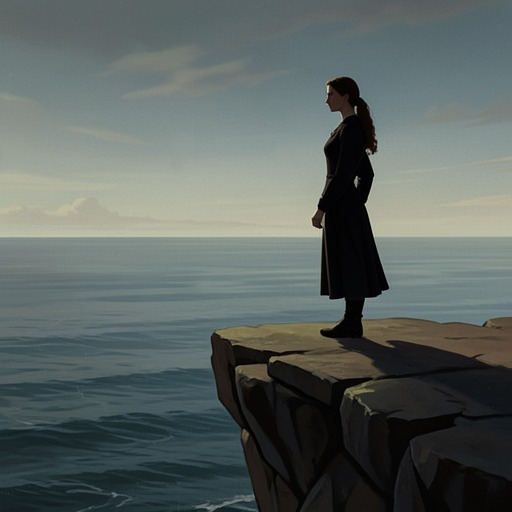
Three Bags FullThe Beach Below the Cliffs is a narrow shore beneath the cliffs, bordered by shifting sand and rocks and sometimes obscured by mist. It becomes a place of uncertain passage and distant observation: Othello crosses it while looking for tracks, Mopple the Whale reaches the edge of The Abyss, and the flock sees the butcher lying below from the cliff top.
Setting and Passage
Mist drifts across the beach, occasionally thinning enough to open a view. For Mopple the Whale, that brief clearing reveals not a destination but the edge of The Abyss; he steps backward carefully and turns away, allowing the mist to close around him again. The moment makes the shore a boundary as much as a route, where visibility can expose a danger without offering a way forward. Othello travels along the beach in search of tracks. The sand shifts beneath his feet, and a hole that had seemed a problem proves manageable once he trusts himself to cross it. He hears loud yelling farther off, but it does not seem close enough to threaten him. Curious as he is, he continues toward the village, decides he must be near it, and leaves the beach rather than investigate the noise.
The Beach Below the Cliffs
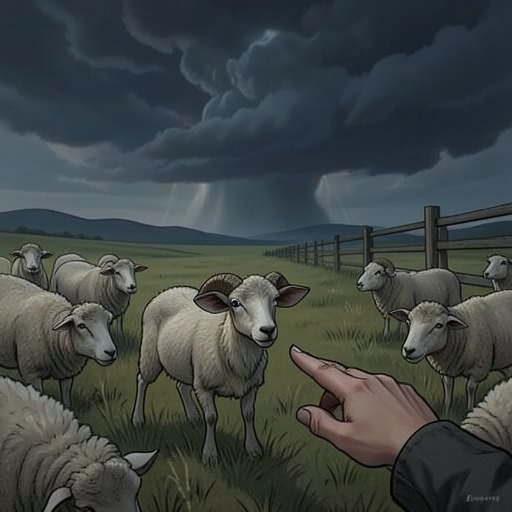
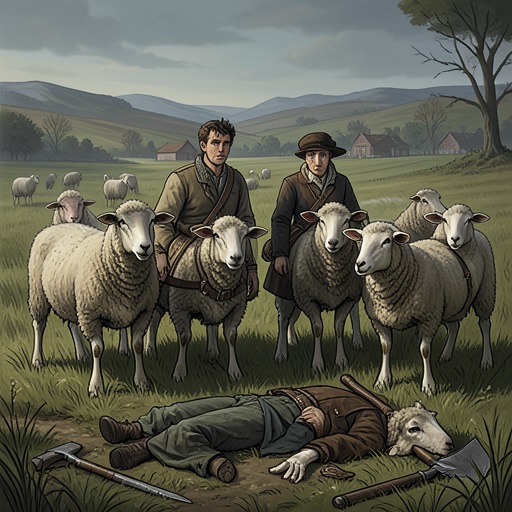
The shore also becomes visible from above. Around midday, Zora goes to the cliffs, and the sheep gather as close to The Abyss as they dare. From there they see the butcher on a small patch of sand among many rocks, lying on his back and apparently still. Sir Ritchfield claims to see blood, but the flock does not trust his account. Their attention shifts when the butcher opens one eye, looks across the sheep as if searching for something, and closes it again. The beach thus gives the flock a view of the scene without bringing them down to it: distance and height shape what they can see, and how uncertainly they can interpret it.
Narrative Significance
Across these episodes, the beach is both a route through unfamiliar ground and a precarious edge. Othello responds to its physical obstacles by trusting his footing and moving onward; Mopple retreats when the mist reveals the drop; the flock watches from above but cannot be sure what the butcher’s stillness means. The same landscape therefore produces different forms of caution: passage, retreat, and observation. Its shifting sand, obscuring mist, and rocky shore make the boundary between what is visible and what is understood central to the location’s role.